
Beyond the Rooftop Tent

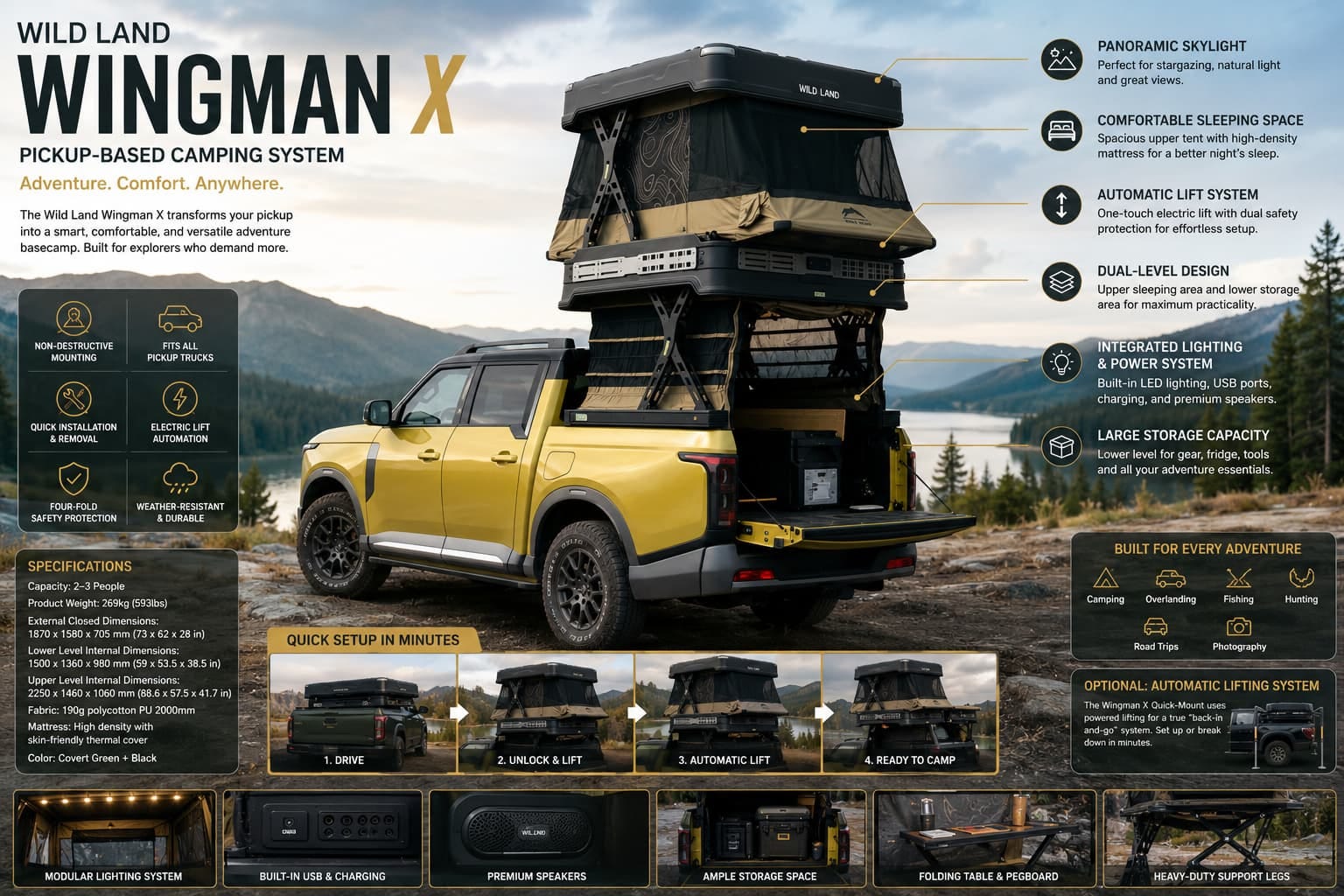
Traditional rooftop tents changed outdoor travel by making camping faster and more mobile. They removed the need for ground tents and improved access to remote locations.
But rooftop tents still came with limitations.
Storage remained an issue.
Cooking space remained improvised.
Setup time could still be frustrating.
And once installed, many systems reduced the practical use of the vehicle itself.
The new generation of pickup-based systems takes the rooftop tent concept and expands it into a much larger ecosystem.
The Wild Land Wingman X is a strong example of this shift.
Rather than simply sitting on top of a vehicle, the system transforms the rear tray area into a multi-level adventure platform that integrates:
Sleeping
Storage
Lighting
Charging
Automated lifting
Expandable cargo capacity
Modular organization
It effectively creates a compact mobile basecamp.
The Rise of Modular Outdoor Living
One of the biggest changes in modern outdoor travel is the demand for flexibility.
People no longer want fixed-purpose camping systems.
They want modularity.
A vehicle may need to function as:
A daily driver
A work vehicle
A family road trip platform
A fishing setup
A hunting vehicle
A remote photography base
A long-distance touring rig
All within the same month.
The appeal of systems like the Wingman X is that they maintain the underlying utility of the pickup platform while adding temporary living capability.
That flexibility matters.
Especially in markets like New Zealand, Australia, and North America, where outdoor travel often involves:
Gravel roads
Beach access
Mountain environments
Remote campsites
Weather variation
Long driving distances
Large RVs and caravans can struggle in those conditions.
Compact pickup-based systems do not.
The Technology Shift in Camping Systems
Another major transformation occurring in the outdoor industry is the integration of smart technology.
Camping equipment is no longer purely mechanical.
Today’s users expect:
USB charging
Integrated lighting
Smart power systems
Automated deployment
Remote controls
Solar compatibility
Connectivity support
The Wingman X reflects this shift clearly.
Its powered lifting systems, remote operation, integrated lighting, and modular electrical features represent the broader direction the industry is heading.
Modern overlanding is becoming increasingly technology-driven.
People now travel with:
Drones
Portable fridges
Battery stations
Starlink systems
Camera equipment
Smart devices
Portable workstations
Outdoor systems are adapting to support this connected style of travel.
Why Setup Speed Matters More Than Ever
One of the most underrated aspects of modern camping design is setup efficiency.
Older camping systems often required:
Complex unfolding
Multiple poles
Ground anchoring
Manual lifting
Lengthy setup times
That process may be acceptable for extended camping trips, but it becomes frustrating during fast-moving travel.
Modern travelers increasingly prioritize:
One-night stopovers
Multi-location road trips
Flexible itineraries
Fast deployment
Reduced physical effort
The ability to stop, deploy camp quickly, and move again the next morning is becoming a major selling point.
This is why powered deployment systems are becoming increasingly popular across the industry.
Convenience is no longer considered a luxury feature.
It is becoming an expectation.
The Influence of Remote Work and Flexible Lifestyles
Another reason vehicle-based adventure systems are growing is the rise of remote and hybrid work.
People are spending more time traveling while remaining connected professionally.
The modern concept of “mobile living” has expanded beyond van life into something much broader.
Pickup platforms now offer:
Better off-road capability
Easier towing
Greater versatility
Lower running costs
Better maneuverability
Multi-purpose use
For many travelers, that balance is more practical than owning a dedicated campervan or motorhome.
As a result, integrated tray-based camping systems are filling a rapidly growing niche.
Compact Adventure Without Sacrificing Capability
What makes systems like the Wingman X interesting is that they attempt to solve one of the oldest problems in outdoor travel:
How do you increase comfort without losing mobility?
Historically, adding comfort usually meant adding size.
Bigger caravans.
Bigger campers.
Bigger trailers.
But modern overlanding is increasingly moving in the opposite direction.
The focus now is on:
Compact efficiency
Smart storage
Lightweight construction
Fast setup
Minimal wasted space
Multi-use functionality
The Wingman X reflects this design philosophy well.
It creates a surprisingly capable living setup while maintaining the agility and off-road characteristics of the pickup itself.
The Future of Pickup Adventure Platforms
The broader overlanding industry is still evolving rapidly.
Future systems will likely continue integrating:
Solar power
Smart automation
Lightweight composites
Battery integration
AI-assisted monitoring
Expandable modular sections
Advanced storage systems
Climate management features
The line between camping equipment and mobile architecture is becoming increasingly blurred.
What was once a simple rooftop tent is evolving into a complete mobile outdoor ecosystem.
And as outdoor lifestyles continue to grow globally, pickup-integrated systems are likely to become one of the defining categories of modern adventure travel.
The appeal is easy to understand.
Freedom.
Mobility.
Comfort.
And the ability to go further without carrying the limitations of traditional travel systems behind you.